In-house product — our third shipped tool
Know the truth.
Say it on the record.
Our first two products made physical things. This one manages the work of making anything: a program management workspace that shows what needs attention, why a program is at risk, and exactly what you told stakeholders last week — without the weeks of configuration a portfolio suite demands first.
Why we built it
Running our own products taught us where delivery actually breaks. It isn't that nobody knows the tasks — it's that the status in the tool, the reason behind it, and the version told to stakeholders drift apart until nobody can say which one is true.
The tools built for this problem tend to solve it by asking you to configure a portfolio suite first: custom fields, workflow states, permission matrices. Small teams doing genuinely complex work abandon that and fall back to a spreadsheet and a deck rebuilt from scratch every month.
Same reason as our other two products: building our own keeps the craft sharp — the same design and engineering we sell, with no client to hide behind.
The need
A task tracker knows what's left. It doesn't know what you promised.
Task tools answer “what's open?” well. They answer “why is this at risk?” badly, and “what did we tell the funder in March?” not at all — that lives in a slide deck someone rebuilt from memory.
So the reporting layer gets assembled by hand, late, under pressure. It ages the moment it's sent, and when someone asks six months later what was known at the time, the honest answer is that nobody can reconstruct it.
That's the gap: delivery, the reasoning behind its health, and the record of what you actually said — in one place, where the record stays fixed.
Recorded in the product
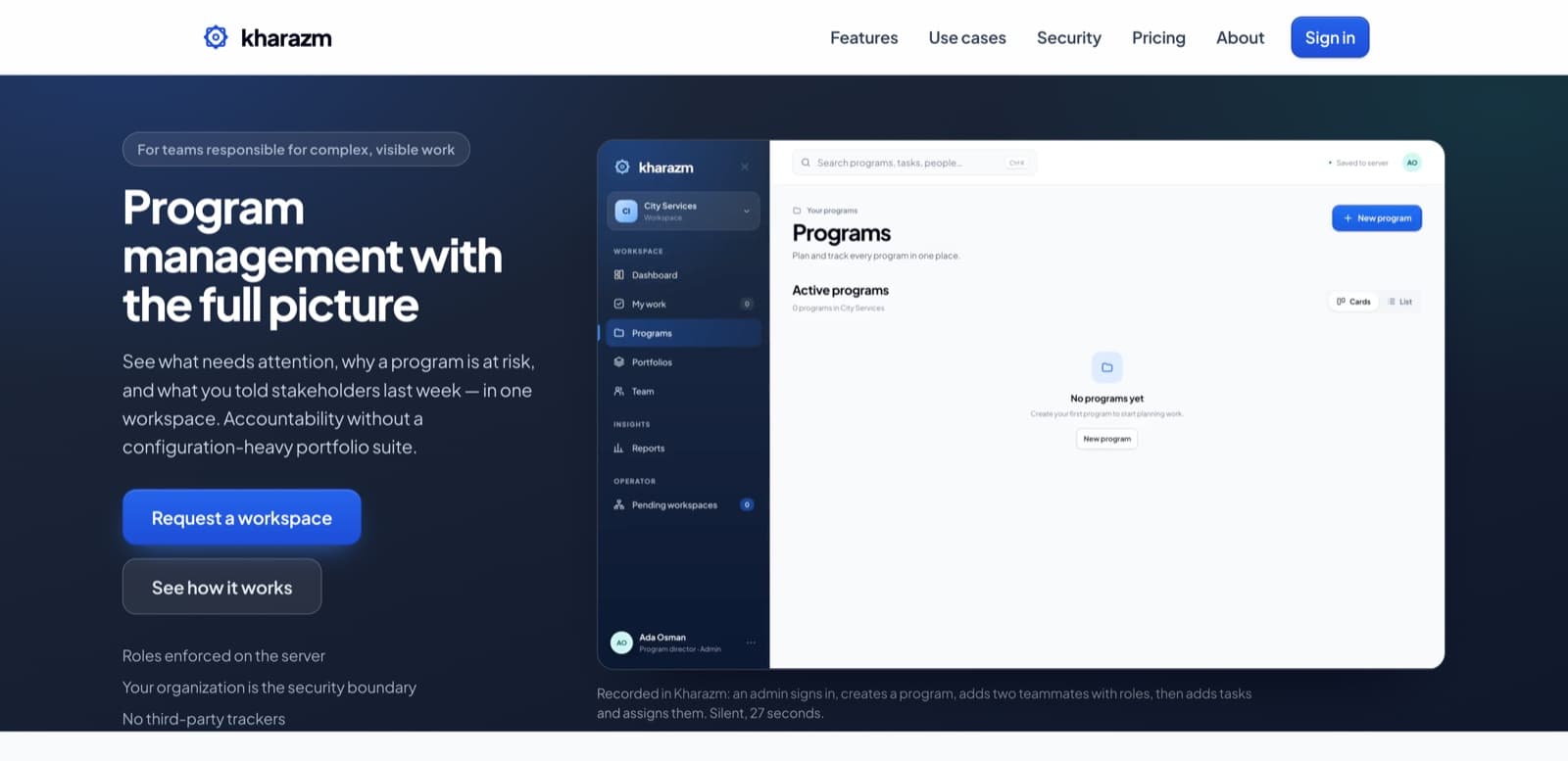
Not a mockup — the real workspace, start to finish.
An admin signs in, creates a program, adds two teammates with roles, then adds tasks and assigns them. No narration, no editing tricks — 27 seconds of the actual tool.
The journey
From an unnamed worry to a record you can stand behind.
We mapped this journey the same way we do for clients — not as a funnel, but as a series of moments where trust is either earned or lost.
01
Shape the program
A program starts with an owner, dates and objectives — not an empty board. What it is and who answers for it are settled before any task exists.
02
See it four ways
Board, list, timeline and workflow chart read the same underlying work. You switch view to change the question you're asking, never to re-enter the data.
03
Log what could go wrong
Risks, assumptions, issues and decisions live beside the plan, so the reason a program is at risk sits next to the work it threatens instead of in someone's inbox.
04
Judge the health
On track, at risk, off track — set by a human, not computed from a progress bar. A percentage can look healthy while the one blocking dependency quietly sinks the date.
05
Publish the update
A stakeholder update is published as a fixed, read-only snapshot with its supporting evidence. What you said last week stays exactly as you said it.
The design
Six decisions that make it trustworthy, not just tidy.
Anyone can draw a Gantt chart. The hard part — and the part we actually spent our time on — is making the status believable enough to forward without rewriting it.
01
Accountability without configuration
Enterprise portfolio suites make you build the tool before you can use it — weeks of fields, workflows and permissions. Kharazm ships with the structure already opinionated, so a program exists on day one.
02
Updates are records, not drafts
Most tools let history quietly rewrite itself. Here a published update is immutable: it captures the evidence at that moment, so a funder or an executive is reading what was actually true when you said it.
03
Health is a human call
Automatic status derived from task counts is confidently wrong. A delivery lead knows the difference between 80% done and 80% done with the hard part untouched — so the judgement stays theirs, with the evidence attached.
04
Roles enforced on the server
Admin, manager, member and viewer are checked server-side, not hidden in the interface. A viewer who crafts a request still gets refused, because the boundary is real rather than cosmetic.
05
Your organization is the boundary
Multi-tenant isolation means one organization's programs are unreachable from another's, and passwords are hashed with scrypt. Security is a structural property, not a settings page.
06
Nothing watching the watchers
No third-party trackers or analytics scripts. Programs often carry sensitive delivery detail — funding, staffing, what's going wrong — and that isn't ours or anyone else's to harvest.
Who it's for
Teams responsible for complex, visible work.
Cross-functional launches
Owners, milestones, risks and decisions around one visible outcome — so a handoff between operations, policy and technology can't fall through the gap.
Grant-funded programs
Reporting to a funder with a record you can stand behind, because what was reported and when is preserved rather than reassembled at the last minute.
Multi-site rollouts
The same initiative across many locations, moving at different speeds — local variation stays visible while leadership still gets one status.
System migration
The people, decisions and cutover around a platform change, with external dependencies and blocked work surfaced instead of discovered late.
Kharazm — see it live
We didn't stop at the concept. We shipped the platform.
Free for teams up to ten people — every planning view, RAID log, portfolio, report and all four access levels included, with no feature gates. Larger teams move to a published per-person rate.